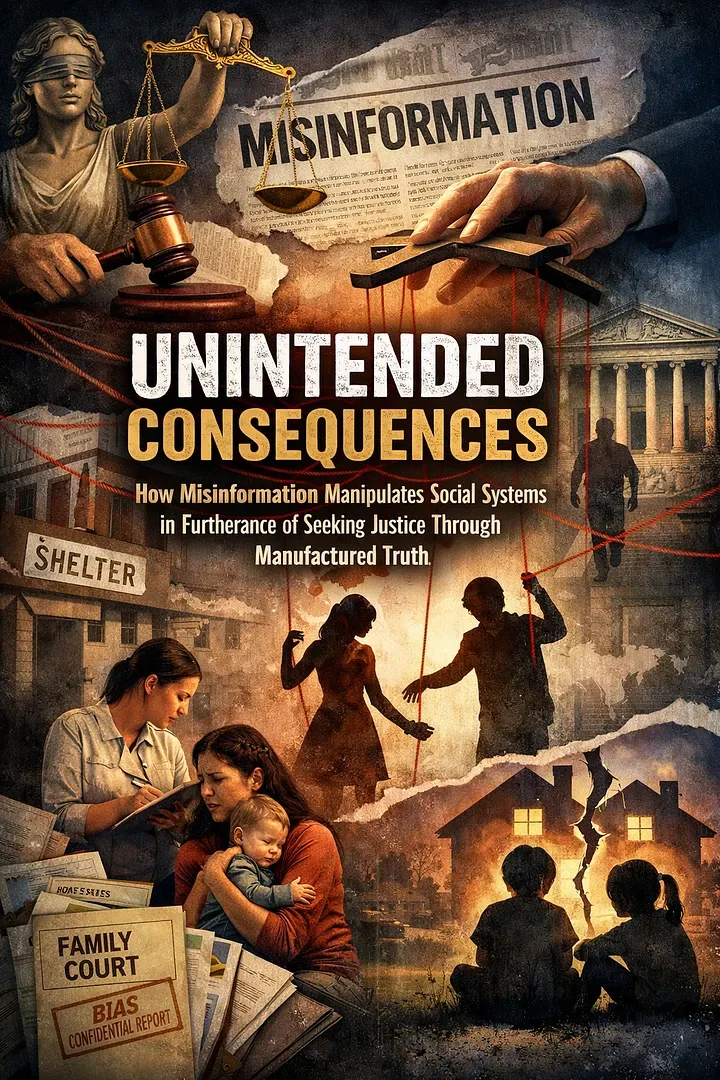
How Misinformation Manipulates Social Systems in Furtherance of Seeking Justice Through Manufactured Truth
Law was never meant to be perfect. It was designed to correct wrongs, to restrain chaos, and to uphold an unwritten promise in democratic societies: do not take matters into your own hands; trust institutions instead. Trust that those entrusted with authority are equipped, educated, thoughtful, and capable of weighing complexity, of life, livelihood, family, and consequence, and of arriving at decisions that are fair, honest, and beyond reproach.
That ideal is the foundation of justice.
But ideals are not outcomes.
No legal proceeding, regardless of the area of law, can ever paint a complete and honest picture of reality. If it could, standards like beyond a reasonable doubt, balance of probabilities, or proportionality of evidence would be unnecessary. Courts would not need inference, discretion, or balancing tests. Truth would be absolute and self-evident.
Instead, law functions on approximation.
Judicial outcomes are not declarations of objective truth; they are conclusions drawn from what is presented, accepted, and believed. And therein lies the vulnerability.
When Belief Replaces Scrutiny
What often goes unexamined is how information enters legal and quasi-legal systems. Rarely do we ask:
- How was this information obtained?
- Was it measured or corroborated?
- Was it tested for bias, exaggeration, or strategic framing?
- Was it ever meaningfully challenged?
In practice, the answer is often no.
Institutions under pressure, courts, tribunals, and social agencies prioritize efficiency, risk mitigation, and perceived vulnerability. This is not always malicious. Sometimes it is fatigue. Sometimes it is institutional fear. Sometimes it is simply the desire for a “clean” outcome.
But these conditions create fertile ground for misinformation, not always fabricated outright, but selectively curated, strategically framed, and rarely interrogated.
Actors within society learn this. Some master it.
Manufactured Truth as Strategy
There are individuals who understand systems not as instruments of justice, but as mechanisms to be leveraged. They learn which narratives are rewarded, which claims go unchallenged, and which institutions defer to one another without independent verification.
In this ecosystem, truth becomes performative.
Nowhere is this more visible, or more troubling, than in family law.
Ask almost anyone, casually, who they believe will “win” when a man and a woman stand before a family court judge. The answer comes quickly, often without hesitation. That certainty alone should unsettle us. When outcomes are assumed before facts are examined, justice has already shifted from adjudication to prediction.
In such environments, evidence can become secondary to alignment. Circumstances matter less than conformity to a familiar narrative. Once a conclusion is culturally entrenched, contradictory facts are not weighed; they are explained away.
The Role of Institutions as Amplifiers
Consider the role of social agencies. When someone presents themselves to a shelter or a social worker claiming harm, the response is understandably immediate and compassionate. The system is designed to respond to need, not to investigate guilt or innocence. This is where manipulation begins.
But compassion without verification has consequences.
Reports generated under these conditions often end up in courtrooms as neutral, authoritative documents. They are treated as factual, honest, and objective, not as untested accounts recorded under time pressure, institutional bias, or narrative expectation.
Rarely is one party sat down and asked directly: Did this happen?
Rarely is corroboration demanded with the same rigor across all parties.
And almost never is the absence of scrutiny itself scrutinized.
What begins as support can quietly become evidence. What begins as narrative becomes fact. And once embedded, it is extraordinarily difficult to dislodge.
Performance Over Truth
Family law, in particular, appears uniquely vulnerable to this dynamic. Performance often outweighs proof. Consistency with expectation often outweighs contradiction. When similar facts produce radically different outcomes depending on who presents them, something has already gone wrong.
The troubling question is not whether bias exists; it does, everywhere humans decide outcomes. The troubling question is why this area of law appears so resistant to self-correction.
Why is truth often irrelevant once performance is convincing?
Why are outcomes defended even when patterns suggest systemic imbalance?
Why does flipping identical circumstances produce opposite results?
These are not rhetorical questions. They go to the legitimacy of justice itself.
The Unseen Casualties: Children and Time
Perhaps the most devastating consequence of manufactured truth is invisible in the short term. Courts resolve disputes today. Systems close files. Agencies move on.
But children live with outcomes for decades.
Few institutions track what happens ten years later. Few measure whether children subjected to these outcomes thrive, struggle, or disappear into cycles of instability. Decisions driven by fear, speed, or narrative alignment often reappear years later as poverty, trauma, and fractured futures.
What presents today as efficiency can become tomorrow’s social cost.
And because no one follows the thread, the system never learns.
A Question That Refuses to Go Away
Law, justice, and democracy are respected because we believe in their purpose. We trust them because we need to. But trust is not the same as immunity from critique.
The unanswered question remains:
When will truth be examined with the same rigor as performance?
When will family law focus solely on evidence, tested facts, and genuine scrutiny, rather than cultural assumptions or predictable outcomes?
Until that day arrives, misinformation will continue to manipulate systems designed to prevent harm. Manufactured truth will masquerade as justice. And the unintended consequences will not be borne by institutions, but by children, families, and societies left to absorb decisions that were never meant to be final truths, only convenient ones.
Like what you have just read, get a copy of my book.
www.ajeenbeckford.com