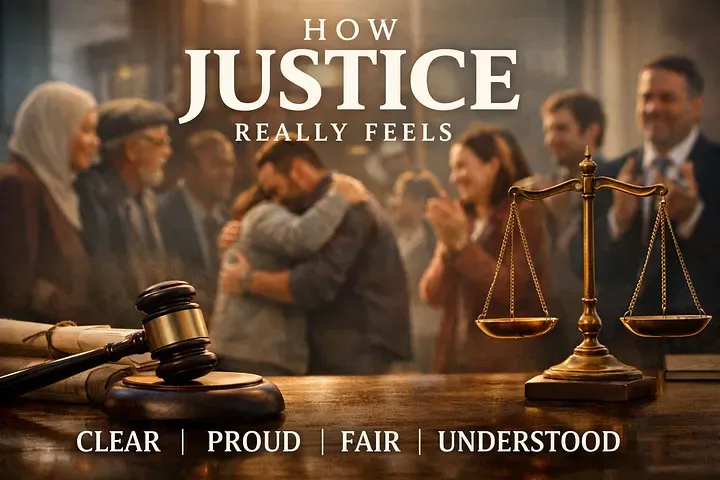
Justice is one of those words that sounds settled the moment it is spoken, firm, resolved, final. It appears singular, clean, almost definitive. Yet justice is anything but simple. It is a broad term that spans human experience, touching on social justice, criminal justice, family justice, cultural justice, and countless other arenas where people seek fairness, recognition, and resolution.
And despite the many forms it takes, justice feels remarkably the same when it is done right.
Justice, at its core, is not merely a legal outcome or an institutional process. It is a mechanism that makes something wrong right, or at least makes it understandable. It is how a nation, a community, or an individual comes to accept that a matter has been addressed in a way that aligns with shared values of fairness, dignity, and truth. When justice is achieved, the outcome should not feel ambiguous or apologetic. It should feel clear. It should feel proud. It should feel whole.
Justice should never need to hide.
When justice is real, it does not live behind sealed files, closed doors, or quiet explanations that require translation by experts. Justice, in its truest form, is an action that can stand openly and confidently before society. It should be unquestionable not because it is beyond scrutiny, but because it withstands scrutiny.
One of the most overlooked truths about justice is that it does not demand education as a prerequisite for understanding. Literacy, credentials, or professional status are not required to feel justice or injustice. A person does not need to know legal doctrine, procedural rules, or institutional language to recognize when something is profoundly unfair.
The feeling of justice and the feeling of injustice are diametrically clear.
No matter where you are born, how you were raised, what language you speak, or what social position you occupy, injustice is unmistakable when it is experienced. Justice is equally recognizable when it is finally delivered. This is why justice transcends borders. Across all 195 countries on this planet, people understand it instinctively.
Take migration, for example. Many people do not leave their home countries solely because of economics or opportunity. Somewhere in that decision, spoken or unspoken, justice plays a role. It might be the pursuit of safety, the expectation of fairness, or the hope that effort will be met with dignity and reward. Justice becomes personal. It becomes aspirational. It becomes the quiet engine driving life-altering choices.
Justice, then, is not confined to laws. It exists outside courtrooms and statutes as a powerful human force. When it works, it reinforces trust. When it fails, it leaves behind something far heavier than disappointment. It produces anxiety, frustration, confusion, and a deep sense of betrayal. Few forces shape emotional and psychological well-being as profoundly as justice denied.
And there is nothing about injustice that requires explanation.
Justice coexists with time. Every form of justice we know, legal, social, moral, is measured against time. Delay does not simply slow justice; it alters it. A delay in justice is not neutral. It is an act of injustice in itself.
Time-based injustice causes harm that no eventual ruling can fully undo. Lives remain in suspension. Relationships deteriorate. Trust erodes. Opportunities disappear. Justice delayed becomes justice diminished, and often justice defeated.
This is where systems falter most severely. Red tape, bureaucracy, bottlenecks, rigid procedures, and inefficiency do not merely inconvenience people; they actively undermine justice. When complexity is ignored, when expediency is treated casually, when familiarity replaces curiosity, injustice is not accidental; it is institutional.
Justice is not black and white when measured against human experience. It is layered, contextual, and deeply interdisciplinary. No single field holds a monopoly on understanding it. A doctorate in one discipline does not confer universal insight into justice itself. Justice draws from law, sociology, psychology, culture, ethics, economics, and lived experience.
When authority is reduced to titles alone, justice risks becoming detached from humanity.
For the person facing injustice, especially someone who may be illiterate, marginalized, or excluded, titles mean little. Outcomes mean everything. They may not understand the language of institutions, but they understand pain, loss, imbalance, and unfairness with perfect clarity. Justice is not validated by credentials; it is validated by consequence.
Justice fails when time is taken for granted.
Justice fails when efficiency is undervalued.
Justice fails when complexity is dismissed.
Justice fails when systems prioritize comfort over courage.
And perhaps most dangerously, justice fails when familiarity breeds indifference, when cases become files, people become numbers, and harm becomes routine.
How justice really feels, when it is done right, is unmistakable. It feels settling without being silenced. It feels firm without being cruel. It feels visible, intelligible, and human. It restores something that was broken, not just in outcome, but in trust.
Anything less may carry the name of justice, but it will never carry its weight.
Like what you have just read, get a copy of my book