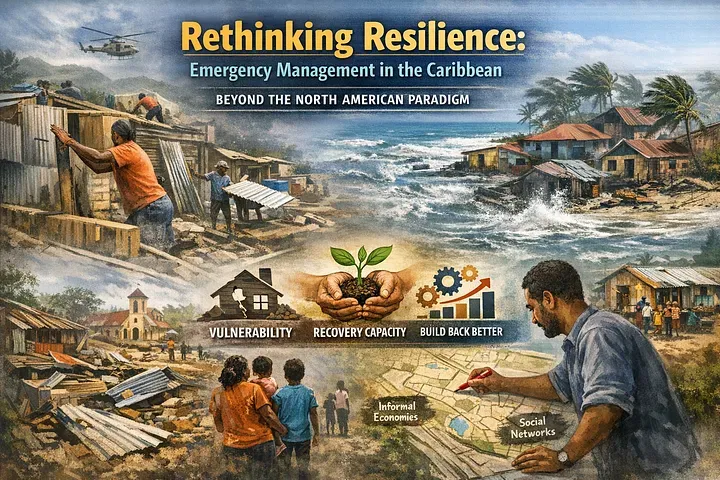
Emergency management in the Caribbean has too often been treated as a scaled-down version of North American disaster doctrine. The language is familiar: prevention/mitigation, preparedness, response, recovery, and the tools are recognizable: hazard maps, risk matrices, probability curves, and damage assessments. Yet the outcomes repeatedly tell us something uncomfortable: when these frameworks are applied without adaptation, they fail to capture Caribbean realities.
This is not a critique of emergency management as a discipline. It is a critique of uncritical transfer.
Volume 2 of my work on Resilience in the Caribbean confronts this tension directly. It asks a fundamental question: What happens when hazard identification and risk assessment are designed for societies with redundancy and mobility, but are applied to societies where vulnerability is place-bound, and recovery is community-dependent?
The Pillars of Emergency Management: Similar Names, Different Meanings
In North America, emergency management is commonly framed around four or five pillars. These pillars operate within a system that assumes:
- Multiple layers of critical infrastructure redundancy
- Strong inter-jurisdictional mutual aid
- Portable livelihoods
- Robust social safety nets
- Highly resourced healthcare and social services
Each critical infrastructure sector, energy, water, transportation, healthcare, and communications, maintains its own internal emergency management capacity. When disaster strikes, people can be relocated, sometimes hundreds or thousands of kilometres away, without losing access to shelter, healthcare, income support, education, or food systems.
The pillars are therefore not only operational tools; they are enabled by the system itself.
The Caribbean Context: Where Disaster Finds You Is Where You Must Recover
In the Caribbean, disaster operates under entirely different constraints.
When a hurricane, flood, earthquake, or volcanic event occurs, the community where the disaster finds you is where recovery must happen. Displacement is often temporary, local, or impossible. Livelihoods are rooted in place. Family networks are spatially fixed. Informal economies dominate. Housing is frequently self-built. Insurance penetration is low. External assistance arrives late, unevenly, or conditionally.
This means that hazard identification and risk assessment cannot stop at physical damage. They must account for:
- The community’s capacity to rebuild
- The availability of local skills and materials
- The fragility of informal livelihoods
- The role of culture, faith institutions, and social cohesion
- The long-term psychological and economic drag of repeated disasters
In the Caribbean, risk is not only about what is destroyed, but it is also about how long it takes to recover, and whether recovery is even possible without permanent loss.
Hazard Identification in the Caribbean Must Be Consequence-Led
Conventional hazard identification often begins with the question: What hazards exist, and how likely are they?
In the Caribbean, a more appropriate starting point is:
What happens after the hazard, and who bears the cost of recovery?
Two communities may experience the same wind speed, rainfall, or seismic intensity, but the consequences are not equal. A concrete home with insurance and access to credit absorbs impact differently than an informal structure built incrementally over decades. A household with remittances recovers differently from one dependent on daily cash income.
Therefore, Caribbean hazard identification must be consequence-led, not probability-led.
It must integrate:
- Recovery time as a risk variable
- Household-level resilience capacity
- Access to credit, remittances, and aid
- Social support density
- Governance and administrative bottlenecks
Without this, risk assessments systematically underestimate long-term harm.
Risk Assessment Must Measure the Ability to “Build Back Better”
Risk in the Caribbean cannot be reduced to exposure × vulnerability. It must also measure the capacity to improve conditions after impact.
In North America, “build back better” is often embedded into insurance systems, building codes, and public reconstruction funding. In the Caribbean, rebuilding is frequently self-financed, slow, and constrained by pre-existing poverty.
A meaningful Caribbean risk assessment, therefore, asks:
- Can this community realistically reinforce structures before the next event?
- Will recovery funds arrive before livelihoods collapse?
- Will rebuilding reproduce the same vulnerabilities?
- Are mitigation measures affordable without external assistance?
If the answer to these questions is no, then risk remains high even after reconstruction.
Expanding the Pillars: Why Caribbean Resilience Requires More
Volume 2 of my book argues that Caribbean emergency management must expand beyond the conventional pillars to explicitly include:
- Community economic continuity
- Cultural and social infrastructure
- Informal systems as first responders
- Long-term displacement risk
- Governance capacity at the local level
Churches, community leaders, market networks, family yards, and informal savings systems are not peripheral; they are core resilience assets. Ignoring them in planning documents weakens response and prolongs recovery.
In North America, redundancy is institutional.
In the Caribbean, redundancy is social.
Why Imported Models Will Always Fall Short
Disaster management frameworks from the United States and Canada are not wrong, but they are contextually incomplete for the Caribbean. They assume mobility, redundancy, and system depth that many Caribbean societies simply do not have.
No amount of technical sophistication can replace:
- Place-based recovery realities
- Community-anchored livelihoods
- Limited fiscal space
- Recurrent exposure to hazards
Until hazard identification and risk assessment are redesigned around these truths, Caribbean resilience will remain aspirational rather than operational.
Toward a Caribbean-Centered Emergency Management Doctrine
True resilience in the Caribbean requires moving beyond borrowed language and inherited frameworks. It requires designing emergency management around lived realities, not imported assumptions.
Hazards will continue to occur. What must change is how risk is understood, how recovery is measured, and how resilience is built, not as an abstract goal, but as a practical, community-grounded process.
Disaster management in North America cannot replace Caribbean emergency management.
It cannot even approximate it.
And until we fully accept that difference, resilience in the Caribbean will remain perpetually unfinished.
Like what you have just read, get a copy of my book,