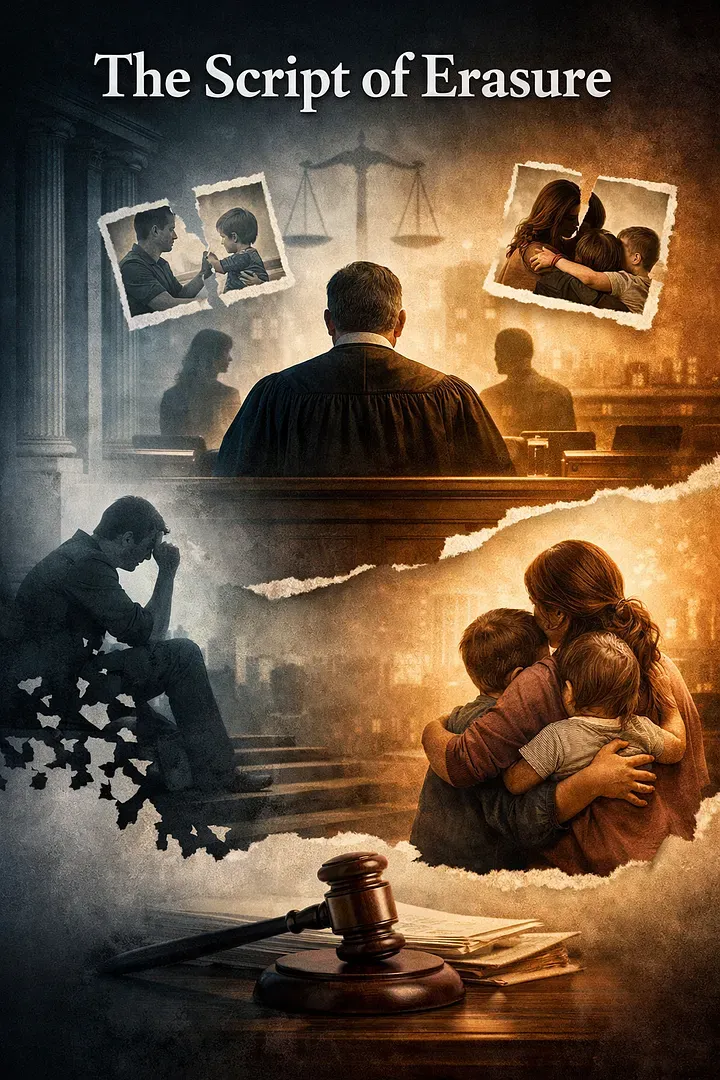
In the silence before modern-day justice speaks, there are often whispers.
They arrive early, before evidence is tested, before arguments are heard, before a judge ever enters the room. These whispers sound like certainty. They speak in assumptions, in expectations, in outcomes that feel already written. Long before a case is called, long before a file is opened, many already “know” how it will end.
For a long time, I resisted believing this.
I wanted to believe that the administration of justice stood apart from rumor and routine, insulated from the casual predictions of the community. I believed, perhaps naively, that justice was blind not only in symbol but in practice. It evaluated facts, not familiarity. That outcomes emerged from scrutiny, not from scripts handed down by history.
But there is a troubling reality in a democratic society when the common person, untrained, unbriefed, uninvolved, can predict the result of a case with confidence. Not because of evidence, not because of nuance, but because of who the parties are perceived to be.
Look at them, they say. You’ll know who the victim is.
And in that moment of collective certainty, something essential is lost.
Because when outcomes are predetermined, justice is no longer a process; it is a performance. And performances require sacrifices. In family law, especially, that sacrifice is often the erasure of one parent.
Erasure is not accidental. It is procedural.
For a predetermined outcome to hold, the narrative must be clean. One parent must become central, constant, indispensable. The other must fade, reduced to margins, minimized, reframed. Children become the axis around which this logic turns, not as individuals with complex needs, but as instruments of justification.
Care is quantified narrowly: who changed more diapers, who spent more hours present, who performed the visible labor of parenting. These acts matter, of course, but they are not the whole story.
What disappears from the calculus is the labor that made those moments possible.
The parent who worked to ensure there was food to place on the table.
The parent who earned the money that paid for diapers, formula, rent, and childcare.
The parent who modeled responsibility, endurance, and participation in society, not through proximity, but through provision.
Somehow, that contribution becomes mute. Irrelevant. Indifferent.
In the eyes of the system, presence eclipses purpose. Visibility overrides viability. The “best interests of the child” are interpreted through proximity alone, as though children do not benefit from stability, for example, from the long view of what adulthood demands.
This logic becomes especially cruel when applied to immigrant families.
Consider the parent who leaves one country for another in pursuit of growth, safety, and dignity. The parent who migrates not out of ambition alone, but out of obligation: to ensure their children’s lives will be easier, fuller, less constrained by scarcity. These parents carry dreams across borders. They absorb sacrifice so their children won’t have to.
But when relationships fracture, as relationships sometimes do, those dreams are suddenly treated as liabilities.
A disagreement. A misunderstanding. A breakdown. And once separation enters the civic record, everything that migration once symbolized, hope, courage, aspiration, is reframed as abandonment. The pursuit of a better future becomes evidence of absence. And absence becomes justification for erasure.
Justice, in this moment, does not merely resolve conflict. It reshapes reality.
Promises dissolve. Futures narrow. Balance is broken.
What follows is not neutrality, but a lifelong imbalance imposed on the child, one parent elevated, the other diminished. Opportunity constricted. Identity fractured. Hope recalibrated downward. And all of it signed, sealed, and delivered under the name of justice.
The most troubling part is how easily contradiction is tolerated.
A parent says they could not work because they were caring for children, while simultaneously having childcare, summer camps, and after-school programs in place.
A parent claims they were discouraged from employment while receiving funds allocated precisely to support employment.
A parent asserts financial dependence, while the record shows insolvency, bankruptcy, mounting debt, and financial collapse on the other side.
These contradictions sit plainly in the record. They ask to be examined. They beg to be questioned.
But questioning would disrupt the script.
So instead, declarations are accepted at face value. Scrutiny is selective. Evidence becomes ornamental. Financial ruin is irrelevant if it complicates the predetermined outcome.
Work, or the refusal to work, requires no justification beyond narrative convenience. Self-conflict is overlooked. Accountability is optional. All that matters is what is said, not whether it coheres.
And so, the whispers prove accurate.
Not because justice is blind, but because it sees selectively. Because it practices a willful blindness that preserves outcomes already culturally agreed upon. Because the system, in some corners, has learned to prioritize familiarity over fairness.
This is how erasure becomes normalized.
Not with malice, but with routine.
Not with conspiracy, but with convenience.
Not with justice, but with the appearance of it.
And that is the most dangerous script of all.
Like what you have just read, get a copy of my new book
Reflective Waters — The Fulcrum on Which Injustice Pivots