Poverty is often explained away with simple narratives.
Bad luck.
Poor choices.
Not working hard enough.
A family history that never learned how to escape scarcity.
Sometimes those explanations are true. Often, they are convenient.
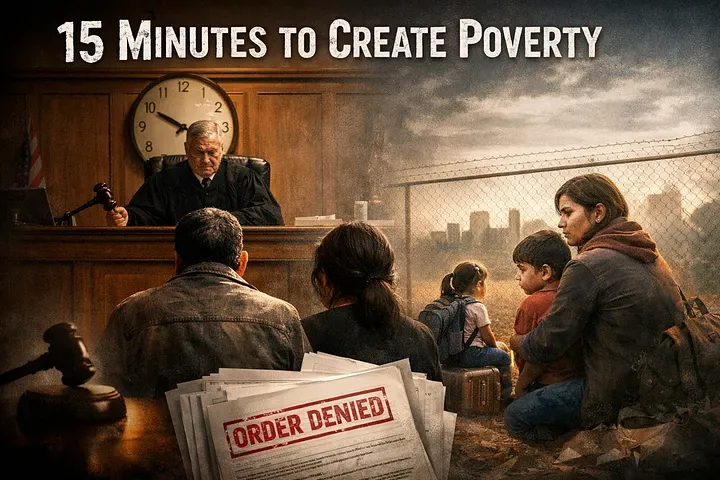
They ignore the quieter truth, that poverty can be manufactured, abruptly, by systems that operate with authority, speed, and indifference. It can be created not over generations, but in a single moment. Sometimes, in fifteen minutes.
The Myth of Gradual Decline
We are taught to believe poverty arrives slowly. It creeps in through years of unemployment, mismanagement, or indiscipline. That it is predictable and earned.
But for many people, particularly immigrants, poverty does not arrive through gradual erosion. It arrives through interruption.
Immigration has always carried a promise: endure now so your children can thrive later.
Sacrifice today so tomorrow is lighter.
Work harder, study longer, delay comfort, because the next generation will stand taller.
For many, that promise is not naive. It is lived. It is calculated. It is earned through education, credentials, multiple jobs, and relentless self-improvement.
Until it isn’t.
Fifteen Minutes With a Stranger
Sometimes all it takes is fifteen minutes with someone who has never met you.
Someone who does not know your history.
Your sacrifices.
Your debts.
Your education.
Your plans.
Your children’s needs.
Your resilience.
They see two people before them.
One story feels familiar.
The other feels complicated.
And complexity is inconvenient.
So you become small.
You become a file number.
You become a conclusion.
An order is issued.
And in that moment, quiet, procedural, efficient, everything changes.
When Authority Collapses a Future
In fifteen minutes, years of planning can be erased.
The degree you returned to school for.
The career you were rebuilding.
The fragile financial balance you were finally stabilizing.
The hope that your children would access a quality of life you never had.
You might have been turning the corner.
You might have been close.
You might have had all the ingredients in place.
But proximity to success is irrelevant when power decides otherwise.
From that moment on, survival replaces growth.
Avoiding poverty becomes the central project of life.
Dreams shrink.
Aspirations narrow.
Possibility becomes conditional.
Your children no longer inherit opportunity. They inherit constraint.
The Illusion of Process
We are told the system listens.
That voices matter.
That fairness emerges through procedure.
But by the time you are speaking, the outcome may already be written.
The exchange becomes theatre.
Persuasion becomes ritual.
Participation becomes an illusion.
Not because facts do not exist, but because understanding them requires time, curiosity, and humility. And those are rarely built into systems designed for efficiency, not humanity.
How Poverty Becomes Multigenerational
This is how poverty becomes inherited, not through laziness or incapacity, but through interruption.
A parent destabilized cannot stabilize a child.
A future constrained cannot expand another.
A decision made to solve “today” quietly mortgages tomorrow.
Children do not feel the impact immediately.
It arrives years later, in missed opportunities, delayed education, limited mobility, and inherited stress.
No one traces those outcomes back to the fifteen minutes that caused them.
But they are connected.
Justice as Performance
When justice becomes performance, when outcomes are shaped more by narrative familiarity than lived complexity, it does not merely fail individuals. It engineers inequality.
It does not just decide cases.
It decides trajectories.
And once that trajectory bends downward, reversing it requires something extraordinary. Not effort. Not discipline. Not resilience.
A miracle.
Fifteen Minutes Is All It Takes
Poverty does not always announce itself with chaos. Sometimes it arrives quietly, wrapped in language, sealed with authority, justified as reasonable.
Fifteen minutes.
A stranger.
A robe.
A decision.
And a future rewritten, not just for one person, but for generations that follow.
That is how poverty is created.
Not by chance.
Not by failure.
But by systems that confuse speed with justice, and outcomes with truth.