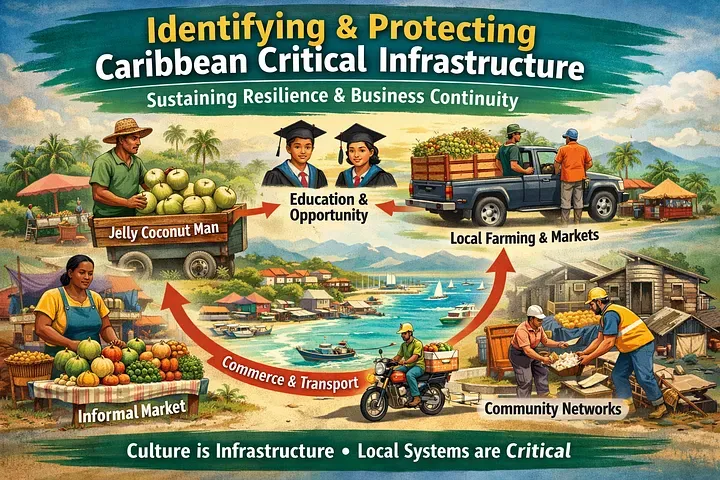
When we speak about critical infrastructure, the conversation is often framed through a North American lens. Banking systems. Telecommunications. Power grids. Transportation corridors. Food and water supply chains. These systems are engineered with layers of redundancy, formal regulation, and institutional oversight. They are stress-tested through large-scale exercises, tabletop simulations, and third-party evaluations designed to identify vulnerabilities and prevent cascading failures.
That framework works, where it was designed to work.
The Caribbean is different. And its definition of critical infrastructure must be different by necessity, not by deficiency.
What Makes Infrastructure “Critical”?
At its core, critical infrastructure is not defined by concrete, steel, or formal registration. It is defined by dependency.
Critical infrastructure comprises the systems, formal or informal, that communities rely on to maintain a basic standard of living, participate in the economy, and ensure social continuity. If one of these systems fails, access to livelihood collapses. Commerce stalls. Daily life becomes unstable. Recovery becomes uncertain.
In other words, if its failure derails a community’s ability to function, it is critical.
In the Caribbean, many of those systems do not appear on national infrastructure lists. Yet they quietly sustain entire generations.
The Informal Economy Is Not Peripheral — It Is Central
Across the Caribbean, a significant portion of economic life operates within the informal sector. Market vendors. Street traders. Small-scale farmers. Transport operators. Community distributors. These actors may hold basic permits or stall registrations, but those documents rarely translate into meaningful policy protection, insurance coverage, or disaster recovery mechanisms.
Registration often exists for one purpose only: to collect fees to maintain the physical market: electricity, water, basic sanitation. It does not acknowledge the economic system embedded within that market.
This is a critical oversight.
Because beneath what appears informal lies a deeply structured, predictable, and interdependent ecosystem.
Culture as Infrastructure
Walk through any Caribbean community, across parishes, islands, or territories, and patterns emerge.
Saturday mornings are for markets.
Friday evenings are for aggregation and distribution.
Farmers move produce to central points.
Vendors source goods through trusted intermediaries.
Transporters connect hillsides to town centers.
These are not random behaviors. They are culturally reinforced systems refined over generations. They govern food access, employment, education, and social mobility.
Culture, in this context, is not symbolic.
It is operational.
And operational systems that sustain livelihoods are infrastructure.
A Jelly Coconut Economy
Consider the jelly coconut vendor, an image so familiar it often fades into the background.
For twenty years, he sells coconut six days a week. Sunday is his only rest. Each Saturday evening, he sources hundreds of coconuts from a central distribution point. A neighbor transports them for a small fee. A farmer in the hills harvests weekly to meet predictable demand.
From this single activity:
- A household is fed
- Utility bills are paid
- A neighbor earns income
- A farmer sustains production
- Two children attend university
Those children grow up with degrees, professional access, and social mobility. They speak in boardrooms. They wear suits. They contribute formally to society. Their children inherit a better starting point.
That transformation did not begin in a financial institution.
It began with a cart, a supply chain, and a community trust network.
This is critical infrastructure.
Emergency Management Was Never Only About Response
The original intent of emergency management was not simply coordination during a crisis. It was to ensure that economic participation is not irreparably disrupted.
Response without continuity is failure.
Recovery without understanding what existed before is an illusion.
If we do not name the systems that sustain communities, we cannot:
- Assess their vulnerabilities
- Protect them from collapse
- Restore them after a disaster
- Prevent generational setbacks
Returning to a “pre-disaster state” assumes we understand what that state was. Too often, we do not.
Hazard Identification and Community Reality
Effective hazard identification and risk assessment must be grounded in lived reality.
In Caribbean communities, this means asking:
- Which cultural systems sustain daily life?
- Who are the economic actors within them?
- Where are the points of failure?
- How is trust substituted for paperwork?
- What continues to function despite disruption?
Some systems endure even under severe strain because they are relational, adaptive, and locally embedded. Others collapse because they are fragile, unprotected, and unrecognized.
You cannot test what you have not defined.
Why Imported Models Fail
Well-intentioned external frameworks often fail in the Caribbean because they attempt to impose solutions without understanding context.
In North America, credit requires paperwork.
In the Caribbean, credit often requires reputation.
In North America, redundancy is institutional.
In the Caribbean, redundancy is social.
You do not need to know your neighbor to access services in the Global North. In the Caribbean, knowing your neighbor is the service.
Trying to “fix” Caribbean resilience using only first-world models, without cultural translation, is not innovation. It is institutional blindness.
Naming Is Protection
When you name something, you define it.
When you define it, you can assess it.
When you assess it, you can protect it.
Community cultural systems must be formally recognized as critical infrastructure. Each community must identify its own ecosystem of actors and dependencies. Disaster risk plans must account for these systems, not as afterthoughts, but as foundational pillars.
Without this, disasters do not merely destroy buildings.
They erase futures.
The Path Forward
Resilience in the Caribbean will not be built solely through concrete, policy, or imported frameworks. It will be built by recognizing what already sustains life, and protecting it deliberately.
Critical infrastructure is not only what looks important.
It is what keeps people alive, learning, earning, and advancing.
If we fail to see it, we cannot save it.
And if we cannot save it, we guarantee that the next disaster will not only damage communities, but derail generations.
That is the cost of not naming what sustains us.
Like what you have just read, get a copy of my book: